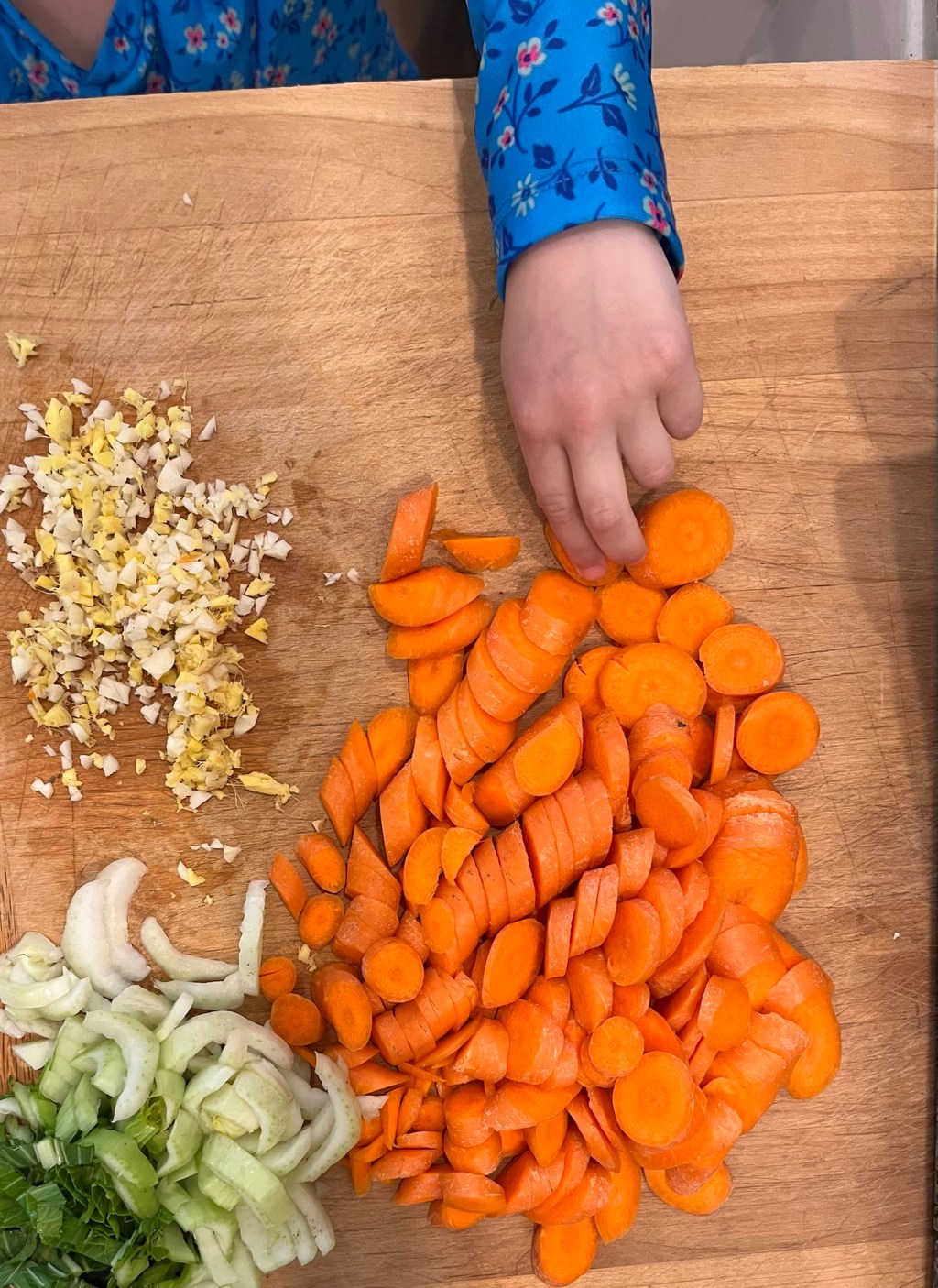
I’ve lost count of how many friends have said to me, “My kids don’t eat vegetables.” And yet, after a visit to our home, those same kids are often caught munching on raw kale, carrots, or cucumbers without a second thought.
Why? Because kids are naturally curious. When we stop turning vegetables into a battle, a bribe, or a punishment, they often engage with them out of simple interest. When we let go of the control and trust their internal cues, something amazing happens: they want to explore.
Just the other day, I was chopping vegetables for a stir fry—carrots, celery, peppers, greens. I stopped at least half a dozen times because little hands kept reaching up to swipe slices. I welcomed the interruptions. Those moments—when they’re stealing raw carrots while I cook—are golden.
That night, our oldest daughter didn’t touch the stir fry on her plate. She ate her rice and called it good. When I asked if she wanted to try my new recipe, she said, “Not today.” And I said, “Okay.” But in the process of making dinner, she ate at least a cup of raw veggies. That’s a win.
Here’s the thing: I trust her. I trust that she knows what her body needs. I trust that when given a wide variety of nourishing, whole foods, she will learn to listen. Some days she might eat mostly carbs, other days it’s protein or vitamin-rich greens. I’m not here to micromanage her nutrient intake each day. I’m here to create a home where she learns to trust her body, to feel confident in her choices, and to know what it feels like to be nourished.
We do have boundaries. We have a family yes/no list of foods, and our kids understand and respect it. They know some foods aren’t welcome in our home—not out of restriction, but protection. We talk about how certain foods are engineered to be addictive and can override our body’s natural hunger and fullness signals.
That doesn’t mean we live in a bubble. Sometimes we say yes to things outside our norm—like team snacks after soccer—and encourage them to notice how they feel. Sometimes they say, “Ew, not for me,” and leave it. Other times they say it was tasty but they feel tired or queasy afterward. That’s learning. That’s wisdom.
Because we homeschool, our kids aren’t constantly exposed to peer influence around food. And that’s intentional. We want them to have the space to discover who they are without pressure to conform. As they grow older and enter environments with more social influence, they’ll carry a strong foundation of self-trust, discernment, and confidence in their choices.
So yes, we’re talking about vegetables. But really, we’re talking about life. We’re talking about raising humans who know who they are, who aren’t afraid to say no, and who aren’t looking for someone else to tell them what to eat or how to be.
I was raised to bend—to please, to follow, to fit in. It took me years to unlearn that. I will not pass that down.
So if your child “doesn’t eat vegetables,” maybe it’s not about the vegetables. Maybe it’s about the environment. The pressure. The power struggles. The lack of trust. Try inviting them to help cook. Let them nibble during meal prep. Offer the veggies again without comment. And most importantly, trust that their bodies are wise—because they are.
Let’s keep the conversation going:
Have you noticed your kids being curious around food when the pressure is off? What strategies have helped your family develop a peaceful relationship with vegetables? Drop a comment below—I’d love to hear your story.
 A Bowl Full of Learners
Leave a comment