“The first five years have so much to do with how the next 80 turn out.”
– Bill Gates Sr.
Decades of child development research confirm what many homeschooling parents already sense: the way we guide our children’s thinking early on has a lifelong impact. A child’s brain develops more than 1 million new neural connections per second in early childhood, and the experiences we provide shape how they learn, relate, and make decisions for life. (Harvard Center on the Developing Child, 2023)
By intentionally cultivating different kinds of thinking, we give our children tools that go beyond academics—we equip them to become empathetic leaders, curious creators, and resilient problem-solvers.
In most traditional school settings, thinking isn’t actually taught—it’s often sidelined. With an emphasis on memorization, standardized testing, and meeting benchmarks, students are rarely given the time or tools to explore ideas, ask big questions, or think critically about the world around them. This approach may produce test results, but it doesn’t nurture curiosity, creativity, or confidence. Research shows that students in test-driven environments have lower engagement and retention, while those encouraged to explore, question, and reflect show higher motivation and deeper understanding. (National Education Policy Center, 2020; [Robinson, Creative Schools, 2015])
That’s one reason we choose to homeschool with a focus on thinking—not just learning facts, but nurturing the skills of thought that will serve our children for a lifetime.
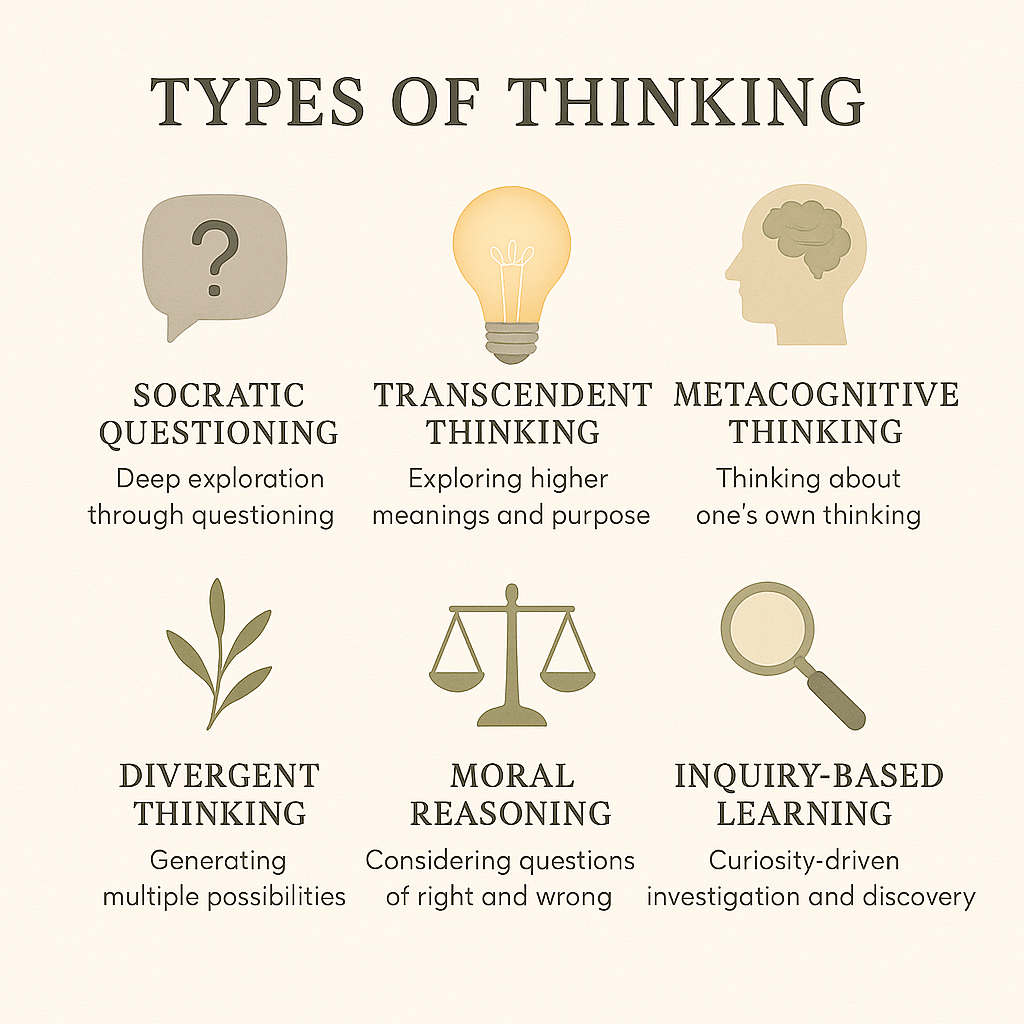
Here are six powerful types of thinking that can be nurtured naturally through conversation, play, and everyday learning:
1. Socratic Questioning
Definition: Deep exploration through questioning.
Why it matters: It helps kids clarify ideas, challenge assumptions, and think critically.
Research says: Socratic dialogue boosts critical thinking, comprehension, and respectful discussion skills.
— Paul & Elder, The Foundation for Critical Thinking
2. Transcendent Thinking
Definition: Exploring higher meanings and purpose.
Why it matters: Supports identity development and a sense of purpose.
Research says: Teens who engage in transcendent thinking show stronger brain connectivity and higher life satisfaction.
— University of Southern California, 2024 study
3. Metacognitive Thinking
Definition: Thinking about one’s own thinking.
Why it matters: Builds self-awareness and empowers kids to become strategic learners.
Research says: Metacognitive strategies can improve student performance by 15–20%.
— National Academies of Sciences, Engineering, and Medicine, 2018
4. Divergent Thinking
Definition: Generating multiple solutions or ideas.
Why it matters: Fuels creativity and flexibility—key for problem-solving in uncertain situations.
Research says: Children who practice divergent thinking score higher on measures of innovation and adaptability later in life.
— Guilford, 1967; Kim, 2006
5. Moral Reasoning
Definition: Considering questions of right and wrong.
Why it matters: Develops empathy, fairness, and responsible decision-making.
Research says: Moral reasoning is strengthened through discussion and real-life dilemmas, not lecturing.
— Kohlberg’s Theory of Moral Development
6. Inquiry-Based Learning
Definition: Curiosity-driven investigation and discovery.
Why it matters: Sparks lifelong learning and helps kids become confident researchers.
Research says: Children retain 30–50% more when they discover answers themselves.
— Educational Psychology Review, 2020
In our homeschool, we think of each of these as a nourishing scoop into our bowl of learning—each one shaping not just what our kids know, but who they become.
With time and intention, these types of thinking will begin to weave naturally into your days. You’ll find yourself asking better questions—and so will your children. Before long, they’ll start thinking more deeply, solving problems creatively, and reflecting on their choices with confidence.
This isn’t about adding more to your plate—it’s about stirring more purpose into what you’re already doing.
Which type of thinking feels most natural to nurture right now? Share in the comments—I’d love to cheer you on in your journey!
Follow our story as I share real-life examples of how I weave this type of thinking intentionally throughout the day with our four children.
 A Bowl Full of Learners
Leave a comment